


 Search
Your server goes down on a Monday morning. Your team cannot log in. Sales calls are missed, orders are delayed, and every minute costs money. If your business has ever faced that scenario, you already understand why IT support services are not optional.
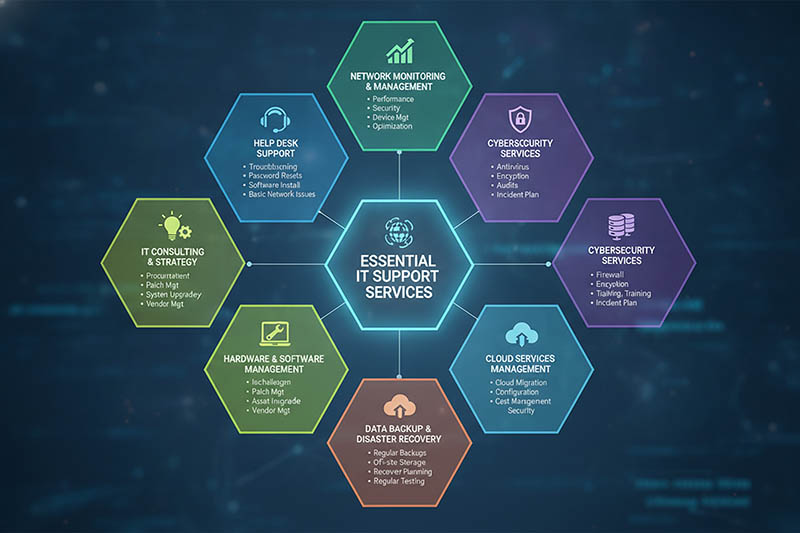
For SMEs across Northeast Ireland, the gap between “we have a tech person” and “we have reliable IT support” is where real business risk lives. This guide walks through the eight IT support services that every business needs, what each one does, and why skipping any of them creates problems you will eventually have to pay to fix.
1. Help Desk IT Support Services
Help desk IT support services are the frontline of your IT operation. When a staff member cannot connect to the printer, cannot access a shared drive, or gets locked out of their account, the help desk resolves it fast.
A good help desk does not just fix tickets. It logs recurring problems, spots patterns, and feeds that information back into your infrastructure plan. If three people in your accounts team lose internet access every Tuesday at 9 am, a competent help desk notices before the fourth time.
For small businesses that lack a dedicated internal IT department, partnering with a managed IT services provider delivers expert help desk support without the expense of a permanent full-time employee.
2. Network Monitoring and Management Services
Most IT failures do not happen suddenly. They build quietly: a router running warm for weeks, a switch dropping packets, bandwidth creeping toward its limit. Network monitoring and management services watch your infrastructure around the clock so small warnings do not become full outages.
This is one of the services where managed IT pays for itself the fastest. Catching a failing network component at 2 am costs almost nothing to fix. Catching it at 9 am when 30 staff are trying to work is a different problem entirely.
Proactive monitoring covers:
- Router and switch health
- Bandwidth usage and bottlenecks
- Connectivity across office locations
- Performance of Wi-Fi access points
- Alert thresholds that trigger before failure, not after
3. Cybersecurity Services for Businesses
Cyber threats are not a large company problem. Small and medium businesses are frequently targeted because attackers know they often have weaker defences than enterprise organisations.
Cybersecurity services for businesses cover the full range of protection your company needs: endpoint security on every device, email filtering to catch phishing attempts before they reach staff, firewall management, and regular security audits.
One area many SMEs underestimate is user access control. Who in your company has admin rights? Who can install software? Limiting privileged access is one of the most effective ways to reduce your attack surface, and it costs nothing extra to implement correctly from the start.
A strong cybersecurity setup also includes:
- Multi-factor authentication (MFA) across all systems
- Antivirus and endpoint detection tools
- Staff awareness training
- Vulnerability scanning and patch management
- Incident response planning
4. Cloud Solutions and Migration Support
Moving to the cloud is not a single event. It is a process that requires planning, testing, and ongoing management. Doing it without proper IT support leads to data loss, compatibility issues, and costs that spiral past the original budget.
Business IT support solutions that include cloud expertise help you choose the right platforms (Microsoft 365, Azure, or hybrid options), migrate cleanly, and manage your cloud environment once you are live.
Cloud support covers:
- Platform selection and licensing advice
- Data migration with zero loss
- User access and permission management
- Ongoing cloud cost optimisation
- Compatibility with your current systems and business processes
For SMEs, cloud solutions also enable remote and hybrid work without compromising security or access to business systems.
5. Data Backup and Disaster Recovery
Ask any IT professional what the most common mistake SMEs make, and this is usually the answer: they have a backup, but they have never tested whether it actually restores. A backup that fails during a recovery is not a backup. It is a false sense of security.
IT support services for businesses that include backup and disaster recovery ensure:
- Daily or continuous backups of critical data
- Offsite and cloud-based copies (so a fire or flood does not take your backup with your server)
- Tested recovery procedures with documented restoration times
- A clear plan for who does what when a failure occurs
Recovery time objectives (RTOs) and recovery point objectives (RPOs) are the two metrics that matter most here. Your IT provider should be able to tell you both in plain terms: how long will recovery take, and how much data could you lose in the worst case?
6. IT Infrastructure Management
Your servers, storage, cabling, and on-premise hardware are the foundation everything else runs. Without active management, infrastructure ages quietly until it fails publicly.
Managed IT services for small businesses include infrastructure oversight: hardware lifecycle planning, firmware and OS updates, capacity planning, and physical server maintenance.
One practical detail worth knowing: most hardware manufacturers recommend replacing servers on a five-year cycle. Beyond that, performance degrades, warranty coverage expires, and the cost of failure typically exceeds the cost of planned replacement. A good IT provider tracks your hardware inventory and flags upcoming end-of-life dates before they become your problem.
7. IT Consulting and Strategic Planning
Most SMEs do not need a full-time Chief Information Officer. But they do need someone who understands their business goals and can translate them into a technology plan. IT consulting as part of managed IT services from Ireland gives you access to that strategic thinking without the salary overhead.
A skilled IT consultant helps you:
- Align your technology investment with your business plan
- Avoid paying for tools and licences you do not need
- Plan infrastructure upgrades before they become urgent
- Evaluate new software and systems before committing budget
This is particularly valuable for growing businesses. If you plan to add ten staff members in the next 18 months, your IT setup needs to scale ahead of that growth, not scramble to catch up afterwards.
8. Compliance and Data Protection Support
For businesses handling customer data, financial records, or personal information, compliance is not optional. GDPR in Ireland and across the EU sets clear obligations for how data is stored, accessed, and protected. IT support services in Dublin, Meath, and across Ireland increasingly include compliance support as a standard service.
This covers:
- Data mapping and documentation
- Secure data storage and access controls
- Breach detection and reporting procedures
- Regular compliance reviews as regulations evolve
- Guidance on data retention and deletion policies
Getting this wrong carries real financial and reputational risk. Getting it right, with the support of a knowledgeable IT partner, keeps your business protected and your clients’ trust intact.
The Real Benefits of Managed IT Support Services
The benefits of managed IT support services go beyond fixing problems when they happen. The more significant value is in what does not happen: the outage that does not occur because monitoring caught it at midnight; the data breach that does not happen because patching was kept current; the compliance fine that does not land because your data protection controls were reviewed last quarter.
For SMEs, outsourcing to a managed IT services provider also provides access to a full team of specialists: help desk engineers, network specialists, security analysts, and cloud architects. That breadth of expertise would cost significantly more to build in-house.
Why businesses need IT support services ultimately comes down to one simple truth: your business depends on technology to operate, and technology requires consistent, expert attention to remain reliable.
Work With a Managed IT Services Provider That Knows Your Business
At ImageIT, we provide the full range of IT support services for businesses across Northeast Ireland: from help desk support and network monitoring to cybersecurity, cloud solutions, backup, and compliance. We work as your outsourced IT department so you can focus on running your business without worrying about the systems underneath it.
If you want to understand exactly which IT services your business needs right now, get in touch with the ImageIT team for a straightforward conversation about where you are and where you need to be.
Also Read: How to Choose the Right IT Service Provider for Your Business
Frequently Asked Questions
What are IT support services?
IT support services are professional technical services that manage, monitor, and maintain a company’s technology systems, including networks, devices, software, security, and cloud platforms.
Why do businesses need IT support services?
Businesses rely on technology to operate. Without IT support, systems fail, data is at risk, and productivity drops. IT support keeps operations running reliably and securely.
What is a managed IT services provider?
A managed IT services provider (MSP) is a company that takes responsibility for managing your IT systems on an ongoing basis, acting as your outsourced IT department.
What do managed IT services include for small and medium-sized businesses?
Managed IT services for small businesses include help desk support, network monitoring, cybersecurity, backup, cloud management, and IT consulting delivered as a monthly outsourced service.
What are the benefits of managed IT support services?
Benefits include reduced downtime, proactive monitoring, predictable costs, access to specialist expertise, stronger cybersecurity, and compliance support without the cost of an in-house IT team.
What do help desk IT support services include?
Help desk IT support includes remote and on-site technical assistance for staff, troubleshooting hardware and software issues, account management, and incident logging and resolution.
What cybersecurity services do businesses need?
Businesses need endpoint protection, email filtering, firewall management, multi-factor authentication, staff training, vulnerability scanning, and incident response planning.
What are network monitoring and management services?
These services involve continuous monitoring of your routers, switches, bandwidth, and Wi-Fi infrastructure to detect performance issues before they cause outages.
How do I choose the right IT support provider for my business?
Look for a provider with clear service level agreements (SLAs), local knowledge, a proactive approach to monitoring, transparent pricing, and experience working with businesses of your size and sector.
