


 Search
Hardware Buying Guide
Leasing vs Buying Business Computer Hardware: Which Saves You More?
You’ve fifteen laptops that need replacing by March. The quote from your supplier lands in your inbox, and it’s not small. Do you write the cheque, or do you sign a lease and keep the cash in the business?
The majority of Irish SME owners hit this fork in the road every three to five years, and most of them have no idea. They pick whichever option feels less painful that month, then wonder eighteen months later if they made the right call. This is one of the most common computer system hardware decisions an Irish SME will make.
What "Computer Hardware" Actually Costs You (Beyond the Price Tag)
The sticker price on a laptop or a server is the smallest part of what your computer system hardware actually costs your business. Genuine computer hardware expenses build up across the machine’s entire operational lifespan:
- The purchase or lease price itself
- Setup, configuration, and data migration
- Antivirus, security software, and licensing
- Ongoing maintenance and repairs
- IT support time when something goes wrong
- Eventual disposal or resale value (often close to nothing after four years)
A €900 laptop that needs €200 of support calls a year isn’t a €900 laptop. It’s closer to €1,700 over three years, once you count the hidden bits. This is the number that actually decides whether leasing or buying saves you more, not the number on the invoice.
This is exactly why decisions about computer hardware and software need to be made together, not separately. Buying a laptop without factoring in the software licences and support it needs is only half the sum.
Buying Computer Hardware Outright: What You Get and What You Give Up
The Case for Buying
Buying wins on ownership. Once it’s paid for, it’s yours. No monthly bill, no contract to manage, no renewal date creeping up on you.
For computer system hardware that doesn’t age fast (network switches, printers, some server components), buying can genuinely be the cheaper long-term choice. You’re not paying a lease company’s margin on top of the unit cost.
Where Buying Falls Down
Here’s the part most SME owners underestimate: computer hardware doesn’t fail gracefully. It declines gradually, then breaks down completely. A laptop that’s fine at year three is often struggling by year four, running hot, taking longer to boot, dropping Wi-Fi mid-call.
Buying ties up capital in an asset that’s worth a fraction of what you paid within twelve months. And when it breaks outside warranty, the repair bill is entirely yours.
Leasing Business Computer Hardware: How It Actually Works
Lease computers for small business needs and you’ll usually find it works one of two ways.
Operating leases work like a subscription. You pay monthly, use the hardware, and hand it back (or upgrade) at the end of the term. You never own it.
Finance leases work more like a loan secured against the hardware. You pay it off over time and often have the option to buy it outright for a small residual sum at the end.
Either way, many providers who lease computers for small business clients will also handle the computer hardware and software setup as part of the agreement, so machines arrive ready to work rather than ready to configure.
Many business computer leasing agreements for laptops and desktops in Ireland run three to four years and typically bundle in things like:
- Fixed monthly payments (easier to budget than a lump sum)
- A defined refresh cycle, so hardware doesn’t quietly age past its useful life
- Sometimes maintenance or support, depending on the provider
Here’s a general point worth knowing: lease structures and tax treatment for hardware finance vary by provider and by your company’s specific circumstances. Talk to your accountant before signing anything. This isn’t tax advice, and anyone who gives you a flat “leasing is always better for tax” answer without knowing your numbers is guessing too.
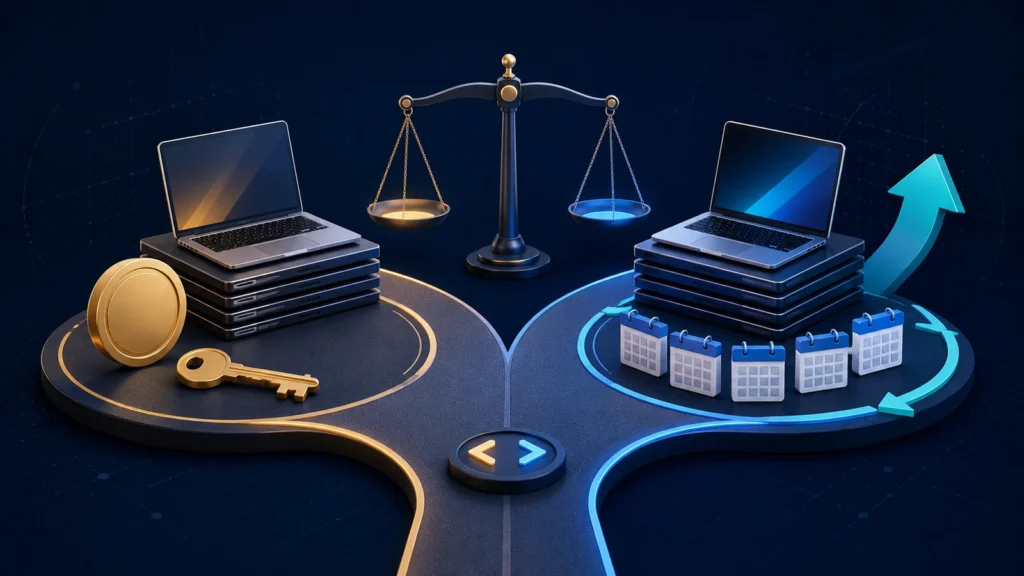
Leasing vs Buying: A Straight Comparison
Whether you buy outright or lease computers for small business use, the comparison below holds the same shape.
| Factor | Buying | Leasing |
|---|---|---|
| Upfront cost | High, paid at once | Low, spread monthly |
| Cash flow impact | Ties up capital | Preserves working capital |
| Ownership | Yours from day one | Usually returned or bought at term end |
| Upgrade cycle | You decide, often delayed | Built into the agreement |
| Repair risk | Yours after warranty | Often covered by the lease |
| Best for | Slow-ageing hardware, stable headcount | Fast-growing teams, laptops, changing needs |
Neither column wins outright. A ten-person accountancy firm with stable staff numbers might do better buying desktops that’ll last five years. A twenty-person software team hiring six new developers this year has a completely different equation.
Where Cloud Computing Hardware Changes the Equation
There’s a third option that’s quietly reshaped this whole decision for a lot of Irish businesses: needing less physical hardware in the first place.
Cloud computing hardware, meaning the servers and infrastructure sitting in a data centre rather than your office, shifts some of the heavy lifting off your desks entirely. If your team runs mostly through cloud-based tools and virtual desktops, the actual laptops or PCs they use can often be lighter, cheaper, and simpler machines, because the demanding work isn’t happening locally anymore.
This doesn’t remove the leasing-versus-buying question, and it doesn’t change the basic computer hardware and software relationship your business depends on. It shrinks the stakes. When the physical hardware just needs to run a browser and a remote session reliably, the gap between leasing and buying gets smaller, and your hardware refresh budget stretches further either way.
Looking After Whatever You Choose: Components and Basic Maintenance
Whether you lease or buy, the hardware still needs looking after. A quick look at the main computer system hardware components that make up a typical business machine, the physical building blocks behind any computer hardware and software setup:
- Processor (CPU): the machine’s thinking speed
- RAM: how many things it can juggle at once without slowing down
- Storage (SSD/HDD): where files and programs live
- Motherboard: connects everything together
- Cooling system: keeps all of the above from overheating
That last one matters more than people think. Dust buildup is one of the quietest killers of business hardware, and it’s entirely preventable.
If you’re wondering how to clean computer hardware safely: power down and unplug the machine first, use compressed air (never a vacuum, which can generate static) to clear dust from vents and fans, wipe external surfaces with a lightly damp, lint-free cloth, and never spray liquid directly onto any component. For internal cleaning beyond the basics, it’s worth having a professional handle it. Getting this wrong risks the exact repair bill you were trying to avoid.
So, Which Saves You More?
There isn’t a universal winner here, and any computer hardware company that tells you there is one is selling you their preferred model, not your best outcome.
Buying tends to save more money over time for hardware that ages slowly and a headcount that isn’t shifting much. Leasing tends to save more stress, and often more cash flow, for fast-growing teams or hardware that needs refreshing every few years regardless.
The honest starting point is working out your actual refresh cycle and your actual growth plans for the next three years. Everything else follows from that.
If you’re weighing this up for your own business and want a second opinion that isn’t trying to sell you a specific answer, ImageIT’s advisory team can walk through your setup and talk through what’s actually worth leasing, what’s worth buying, and where cloud infrastructure might shrink the decision altogether. No obligation, just a straight conversation.
Frequently Asked Questions
It depends on your refresh cycle and growth plans. Buying often costs less long-term for stable, slow-ageing hardware; leasing usually wins for fast-growing teams.
An operating lease is like renting, you return the hardware at term end. A finance lease lets you buy it outright for a small sum afterwards.
Many business computer leasing agreements for laptops and desktops run three to four years, though terms vary by provider and hardware type.
Sometimes. It depends entirely on the provider and agreement, so always check what’s included before signing.
The cooling system is usually the most overlooked. Dust buildup around fans and vents is a common, preventable cause of hardware failure.
For most office environments, every three to six months is reasonable. Dustier settings may need more frequent attention.
Often, yes. If your team relies on cloud-based tools, local machines can be lighter and cheaper, since less processing happens locally.
Tax treatment varies by lease type and your company’s circumstances. Speak with your accountant before assuming any specific tax outcome.
This depends on your specific agreement. Many leases include repair or replacement cover, but it’s not universal, so check the terms.
Look at how fast your team is growing and how quickly your current hardware has aged. That combination usually points to the right answer.
Weighing Up Leasing Against Buying?
ImageIT’s advisory team can walk through your setup and talk through what’s actually worth leasing, what’s worth buying, and where cloud infrastructure might shrink the decision altogether. No obligation, just a straight conversation.